Workshop
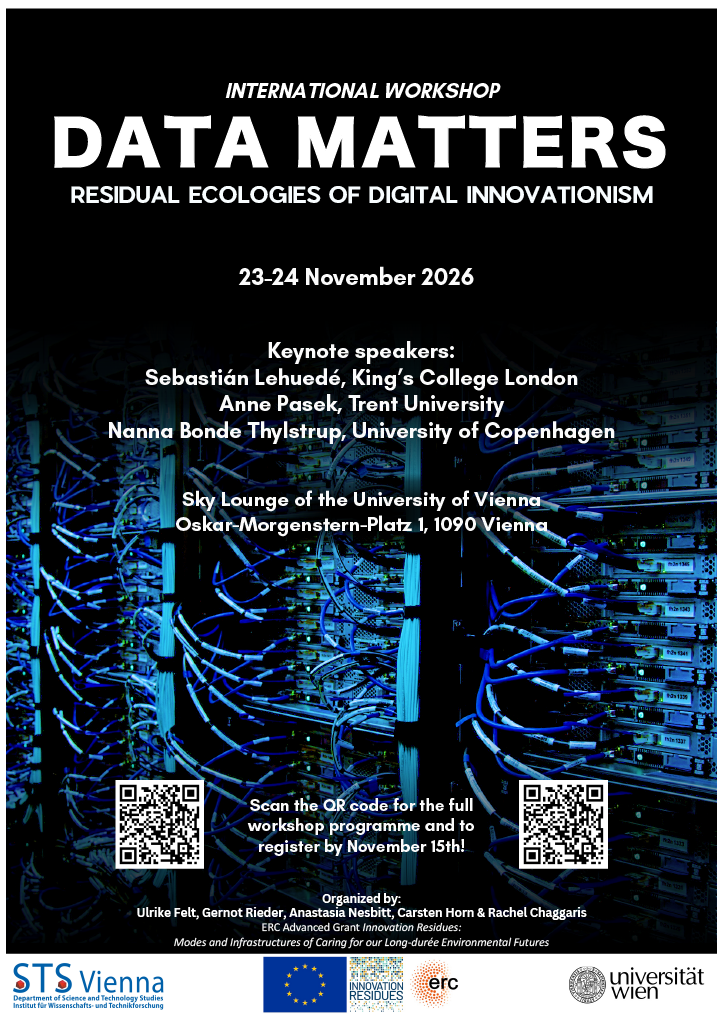
Data Matters: Residual Ecologies of Digital Innovationism
When: 23-24 November 2026
Where: Sky Lounge, Oskar-Morgenstern-Platz 1, 1090 Vienna
Workshop Program: Download PDF
Full conference booklet: Download PDF
The workshop Data Matters: Residual Ecologies of Digital Innovationism investigates the materiality of data and AI through what they leave behind – materially, infrastructurally, epistemically or socially. It brings together a transdisciplinary group of researchers who collectively explore digital infrastructures, data practices and alternative ways of doing data and AI.
Full Call for Papers Data Matters:
Residual Ecologies of Digital Innovationism
Vienna, 23-24 November 2026
Contemporary innovation societies are increasingly organised around digital technologies and infrastructures. With an insatiable appetite for the next new (Valaskivi, 2020), innovationist ideologies present data and artificial intelligence (AI) as solutions to a wide range of pressing societal problems–from healthcare for aging societies to climate crisis mitigation.
In such debates, data and AI are often treated as “bald objects” (Latour 1999), stripped of their entanglements with practices, infrastructures, institutions, environments, social orders, and labour. Data, AI and “the digital” more generally are thought of as immaterial, existing on an ontological plane distinct from material reality–illustrated by various metaphors such as “the cloud” or “virtual reality”.
These assumptions are increasingly being unsettled by critical scholarship. Critical Data Studies has demonstrated that data are assembled through situated practices of production, curation, and mobilization. Critical AI research has traced how epistemological commitments become built into models and with what distributive consequences. Meanwhile, Critical Data Centre Studies has highlighted the material and infrastructural conditions of possibility of the digital–its dependence on energy, water, and extractive resource regimes.
With this workshop, we seek to create a space of sustained conversation across these strands of scholarship. While Critical Data Studies, Critical AI research, and Critical Data Centre Studies share important concerns, they often operate in parallel, developing distinct vocabularies and empirical focal points. We invite participants to collectively explore how these perspectives might be brought into closer dialogue to address epistemological, ontological, and normative questions around both data and AI in an integrated way.
We propose mattering (e.g., Butler, 1993) as a conceptual hinge for this exchange. To ask how data and AI matter is to foreground both their materiality and their significance. On the one hand, “data matters” directs attention to the infrastructures, resources, and labour that sustain digital systems–the data centres in which data are stored and AI models are trained, the energy and water regimes that cool and power them, and the extractive economies that supply their hardware. On the other hand, mattering points to the discourses, imaginaries, and institutional arrangements that render data and AI meaningful, valuable, and actionable within contemporary innovationist ideologies. It invites us to examine how data and AI come to count, for whom, and at what cost.
This dual focus allows us to bring into view what we term the residual ecologies of digital innovationism. Residues come in at least three forms (Felt, 2025):
- Material residues: the by-products and left-behinds of digital systems, including idle data, waste heat, mining debris, e-waste, wastewater, and environmental burdens displaced to peripheral regions.
- Infrastructural residues: the often-invisible architectures that make datafication and AI possible–databases, cables, server farms, grids, cooling systems, and logistical chains.
- Epistemic residues: the imaginaries, paradigms, and styles of thought sedimented through and in data and AI, including dataism, digital solutionism, and (digital) innovationism, alongside marginalized alternatives such as sustainable computing, digital sobriety, and infrastructural restraint.
By centring mattering, we seek to reconnect data and AI to their “hinterlands” (Law, 2004)–the extended networks of practices, materials, and relations that are typically obscured in policy debates and innovation narratives. This move challenges the persistent separation of labour between fields that treat data as epistemic artifact, AI as technical model, or data centres as infrastructure. Instead, it encourages us to examine how these dimensions co-constitute one another. Dataveillance, for example, is not only a question of governance or algorithmic bias; it is also a question of water consumption, energy extraction, and territorial politics. Conversely, data centres cannot be understood solely as infrastructural sites; they are also shaped by the epistemic, spatio-temporal and economic logics of datafication and AI development.
Framing our discussion around mattering thus unsettles the assumption that data and AI are immaterial, frictionless, or inevitable. It foregrounds their embeddedness in social, environmental, and political worlds and opens up space for critical and transformative engagements. Rather than accepting contemporary digital innovationism at face value, we invite participants to interrogate its onto-epistemological claims, its normative commitments, and its material consequences.
This workshop aims to create a common ground for diverse critical perspectives and to foster dialogue across empirical sites and theoretical traditions. We welcome contributions that engage with questions such as:
- How do data and AI come to matter materially, politically, and epistemically?
- What forms of labour, extraction, infrastructural maintenance and residues are obscured in dominant narratives of digital innovation?
- How might we rethink care, responsibility, and sustainability in relation to the residual ecologies of digital innovationism?
- And what alternative imaginaries and practices might emerge if we re-attach data and AI to the networks, relations, and residues from which they are too often abstracted?

Funding
This project has received funding from the European Research Council (ERC) under the European Union´s Horizon Europe research and innovation programme (Grant Agreement 101054580).

Contact
Department of Science and Technology Studies, University of Vienna
Universitätsstraße 7/Stairs II/6th floor
1010 Vienna, Austria
Kolingasse 12-14/ 7th floor
1090 Vienna, Austria
E-Mail: ulrike.felt@univie.ac.at
Phone: +43 4277 49611